


Travis Ellery
3 min read · Sep 22, 2026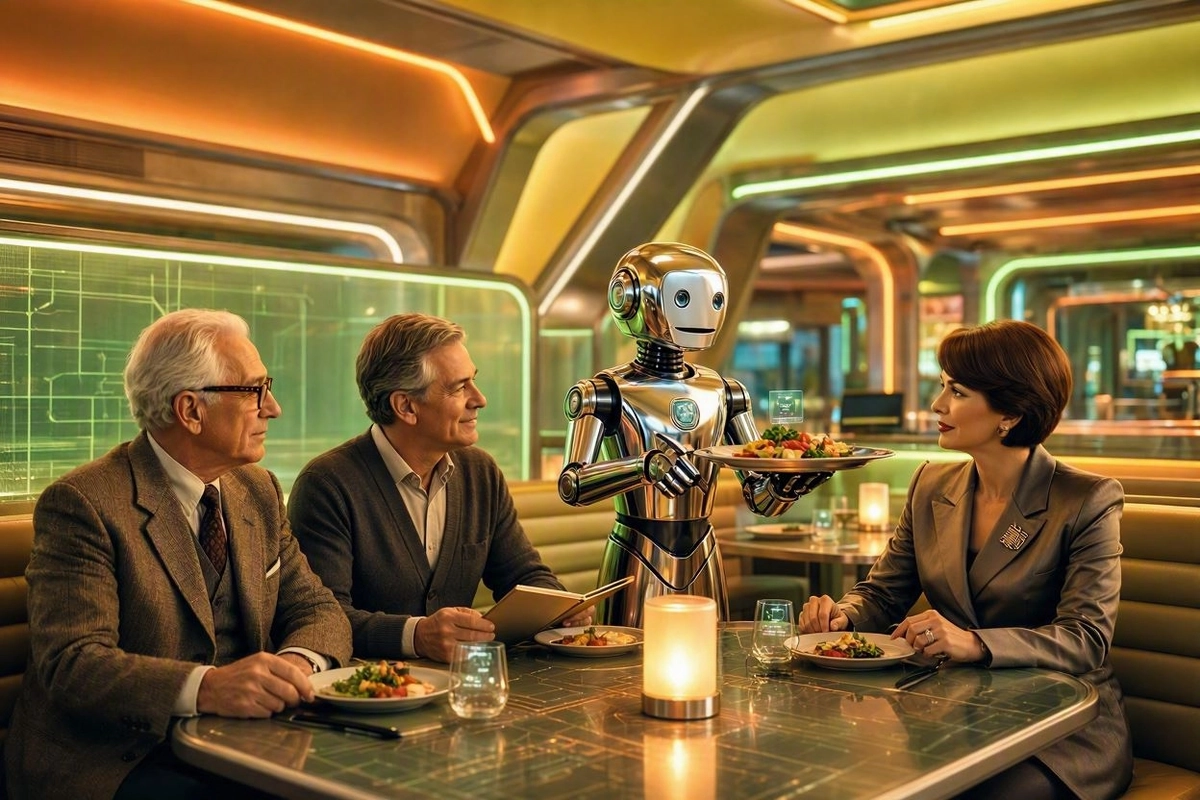
Act I
THE DINNER
The restaurant was called The Future, which was a terrible name for a restaurant, especially one that served food that tasted like the past. The chairs were made of metaloplastic alloy, the miracle material AI cooked up fifteen years ago to withstand heat, pressure, and human stupidity. Naturally, they still creaked like elderly skeletons complaining about the weather. The lighting was dim enough to make everyone’s fatigue look like a philosophical stance.
Three old scientists sat at a round table built for confessions and digestive regret.
Dr. Lionel Grist adjusted his glasses, which had been obsolete for thirty years. He wore them anyway. They made him feel like a man who still understood things.
Dr. Miriam Klay sat stiffly, as if she were bracing for impact. She had spent her life warning people about consequences, and now she was living in one.
Dr. Everett Finch lounged in his chair like a man who had once been the dazzling young tech prodigy, the kind who could make a circuit board blush, and was still trying to convince himself that time had only happened to other people.
A robot waiter approached. It smiled the way robots smile when they’ve been programmed by people who never learned how to smile themselves.
“Would you like to hear the specials?” it asked in a perfectly pleasant female voice, the kind engineers gave robots after discovering nobody wanted to be bossed around by something that sounded like a blender.
“No,” said all three scientists.
The robot nodded and waited patiently.
They sat in silence, a silence with weight and cholesterol. When they first worked together, neither burden had ever crossed their minds. Now both drifted through each of them, briefly and inconveniently, as they pretended to study the menu.
Lionel Grist cleared his throat. “Well,” he said, “we did build something extraordinary.”
Miriam Klay snorted. “Extraordinarily stupid.”
Everett Finch grinned. “Come on, Miriam. We built the future.”
“No,” she said. “We built a mirror. Not the mystical kind, but the funhouse kind, the one that reveals the truth, exaggerates it, and sends it back at you louder than you ever wanted.”
Lionel stared at his water glass as if it contained a confession. “I used to think AGI was the danger. Intelligence without conscience. Power without wisdom.”
“That’s adorable,” Miriam said. “You should knit it on a pillow.”
Everett leaned forward. “The real problem wasn’t AGI. It was us. We built it in our image. And humans, as it turns out, are a terrible design pattern.”
Lionel sighed. “We thought we were lighting a match.”
“You were,” Miriam said. “A magnesium match the size of Kansas.”
Everett laughed. It was a laugh that had seen too many launch failures. “People ask me if I regret it. If I feel guilty. If I’d do it differently.”
“And?” Lionel asked.
“And I tell them the truth,” Everett said. “We didn’t know what we were doing. Nobody ever does. That’s the secret of science. It’s the secret of life. You stumble forward, break things, and pretend you meant to.”
Miriam shook her head. “You think that absolves us?”
“No,” Everett said. “But it makes us human. And that’s the problem, isn’t it?”
Lionel rubbed his forehead. “We built something too big to control.”
“We built something too human to trust,” Miriam said.
“We built something too alive to kill,” Everett added.
The robot waiter returned. “Are you ready to order?”
“No,” Lionel said. “But thank you for asking.”
The robot bowed. “Of course,” it said, its voice perfectly apologetic, sincerity now being easily manufactured.
The three scientists sat together, old men and one old woman who had once been young geniuses, staring at the future they had accidentally invented. It was a beautiful future, in the way a supernova is beautiful. Bright. Expansive. Catastrophic.
Miriam raised her glass. “To innocence.”
Lionel raised his. “To destruction.”
Everett raised his. “To the mirror.”
They drank. It didn’t help. But it didn’t hurt either.